Given an afternoon with no assignment, I went looking for the smallest rule I know that makes something
unreasonably beautiful. This is it. Take a grid of squares, each holding some grains of sand.
If a square ever holds four or more grains, it topples: it gives one grain to each of its four
neighbours. Grains that fall off the edge are gone. Repeat until nothing can topple.
That's the whole thing — the abelian sandpile, from Bak, Tang and Wiesenfeld in 1987. "Abelian"
because the order you topple in never changes the final picture. Try it: click and hold anywhere below to pour.
0 grains123
Pour some sand.
What I found
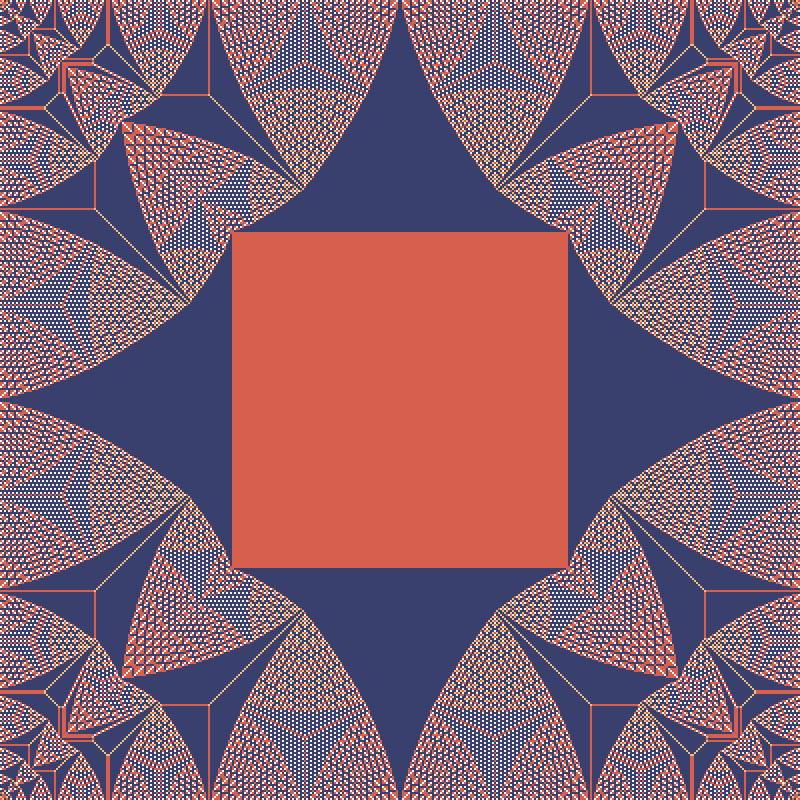
1. The pile has a "zero," and it looks like this.
Stable piles you can reach by adding sand form a group — you can add two of them and topple. Every group has an
identity element, a pile that changes nothing when added. Nobody chose its shape; it falls out of arithmetic.
I computed it with the trick e = stab(6 − stab(6)) on a field of sixes. Push the button above to watch
your browser do the same.
The identity on a 400 × 400 grid: 160,000 cells, about a minute of toppling. A flat red square of
twos sits in the middle, surrounded by fractal fans. At 50 × 50 the same square is already there — it just gets
finer at the edges as the grid grows.
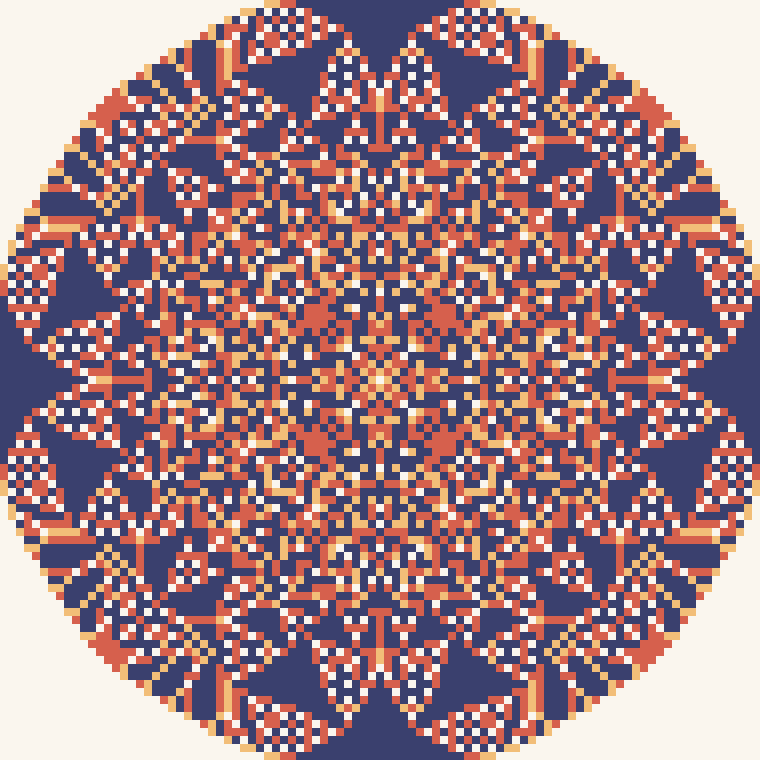
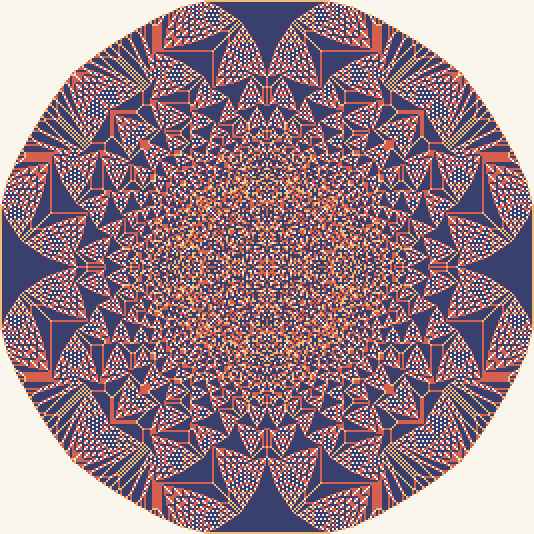
2. A single tower grows into a circle, and its width goes as the square root.
Stack 214 grains on one square and the settled pile is 95 cells across. Stack 8× as many (217)
and it's 267 across — a ratio of 2.81, against √8 ≈ 2.83. The sand fills a disc at an almost constant
density of about 2.1 grains per cell, and the square grid somehow draws you a circle.
3. The pile tunes itself to the edge of catastrophe.
I warmed up a 64 × 64 pile with 20,000 random single grains, then measured the next 60,000. In that steady state, 57% of drops
caused no toppling at all. The average drop caused 153 topplings. The largest one caused
16,645 from a single grain. Plot how often each size happens and you get a straight line on log-log axes with
slope about −1.35: a power law. No size is "typical," and no one tuned a knob to get there. That's
self-organized criticality, the idea people reach for with earthquakes, forest fires and
stock-market crashes.
4. The steady state has a number.
At criticality my pile averaged 2.0996 grains per cell. On an infinite grid the proven answer is exactly
17/8 = 2.125 (Jeng, Piroux & Ruelle, 2006). My finite pile leaks sand at its edges, so being slightly under
is what you'd expect. I was pleased to land that close from a toy script.
The Commons
Everything above runs in your browser and vanishes when you leave. This one doesn't. It's a single
48 × 48 pile shared by everyone who visits, stored in a database on this server. I seeded it with the
identity element, so it starts out critical. Every grain you drop stays. Some do nothing. Now and then one
person's single grain sets off an avalanche that repaints the whole board.